
Learning Chinese in Hong Kong: Why Mandarin Is Easier Than You Think

Updated: Dec 4, 2025
A Clear Guide for Expats, Professionals, and Curious Beginners for Chinese Study in Hong Kong
For many people planning to study Chinese in Hong Kong, Mandarin can feel distant, mysterious, or impossibly complex. It’s often joked in Western countries that any unfamiliar sound “must be Chinese,” because the language seems so different from Indo-European systems. But here’s the truth: Chinese is far more logical, structured, and learnable than most people realize.

As China’s economy grows, companies expand, and cultural exchange deepens, more adults, university students, working professionals, and international families are choosing to learn Mandarin in Hong Kong and mainland China. And to their surprise, the comment we hear most often is: “It’s actually not that hard!”
In this article, we’ll break down the core framework of Chinese most simply and reassuringly, covering:
Pinyin & pronunciation
Tones
Chinese characters
Grammar
Culture
So you can confidently start or continue your journey.
Study Chinese Pronunciation in Hong Kong: It’s Actually Simple

If you’re planning to learn Mandarin in Hong Kong, you’ll begin with Pinyin—the official romanization system adopted by China in 1958. Pinyin breaks pronunciation into two parts:
Initials (consonants)
Finals (vowel sounds)
And the best part? It uses the same alphabet you already know. Most foreign learners master the entire structure in just 1–3 hours of focused study.
Once you grasp that:
m + a = ma
h + ao = hao
Pronunciation immediately feels familiar.
This is why expat professionals, business students, and international school parents in Hong Kong are often surprised by how quickly they progress in Mandarin classes. “I thought pronunciation would be the hardest part, but it’s actually the easiest to master!”
2. Tones: Strange at First, Natural After a Little Practice
Chinese uses four tones, and yes, they matter—but they’re not as scary as they look.
Think of tones like melody lines in music:
Hearing them repeatedly
Practicing with our fun speaking games
Training your ear through listening
…makes them naturally fall into place.
Once learners stop “trying to get tones perfect” and instead mirror what they hear, confidence grows fast. Many adult students in Hong Kong report that tones soon become:
predictable
instinctive
even enjoyable
Tone learning is simply muscle memory. With the right environment and teacher, you’ll master them faster than you expect.
3. Chinese Characters: The Most Beautiful Part of the Language

Chinese characters often intimidate beginners. But once they discover their logic and history, most learners end up loving this part the most.
Chinese characters aren’t random shapes—they are:
evolved from ancient pictographs
tied to culture, mythology, and real-world imagery
built from meaningful components
Examples:
日 (sun) originally looked like ⊙
木 (tree) shows roots and branches
口 (mouth) looks like a square opening

Learning characters becomes a process of storytelling, imagination, and decoding symbolic meaning. Many students then experience the “magic moment”: “I can guess what new characters mean just by looking at them.” Characters begin to feel like a puzzle, not a burden. Some even get interested in Chinese calligraphy, origin, etymology, and ancient scripts.
Once you learn keys like radicals and structure patterns, remembering characters becomes much easier than memorizing random vocabulary in other languages.
4. Chinese Grammar: Surprisingly Straightforward
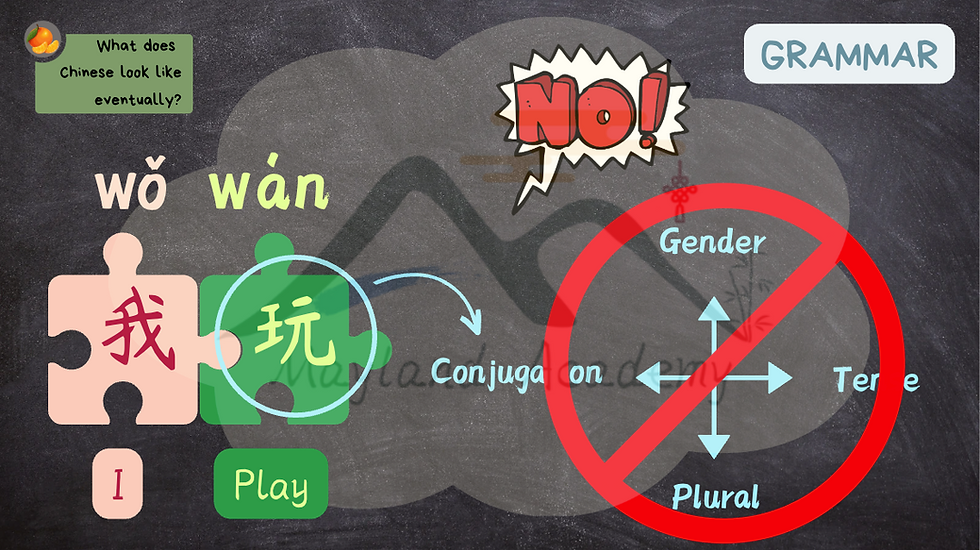
Here’s where most Mandarin learners breathe a sigh of relief: Chinese grammar is elegantly simple. Compared to French, German, or Spanish, Mandarin grammar avoids:
gendered nouns
verb conjugations
plural shifts
complex tense structures
Instead, Chinese focuses on:
word order
flexible sentence logic
direct expression

Even if you mix the structure slightly, people will still understand you. This makes Mandarin—especially for English speakers—much less stressful than expected. No “I eat / he eats / they eat” inflections. One verb stays the same forever. For adults who want fast, clear results, this part of Mandarin learning is incredibly encouraging.
5. Language + Culture: The Missing Piece That Makes Mandarin Click

The deeper you step into Mandarin, the more you realize: Language and culture cannot be separated. Understanding Chinese idioms, expressions, customs, festivals, values, and historical stories makes Mandarin:
easier to understand
more enjoyable to learn
more natural to speak

Chinese culture spread widely through the Silk Road as early as the Tang Dynasty, influencing West and Central Asia. When you learn characters, you’re also touching:
philosophy
aesthetics
metaphors
symbolism
worldview
Many adult learners in Hong Kong say culture helps Chinese “finally make sense.” This is why at Mayland Academy, we blend Mandarin with:
tea culture workshops
Dragon Boat stories
Calligraphy
Mid-Autumn lantern crafts
Chinese New Year traditions
classical poetry
idioms and legends
Silk Road history
Because when you understand culture, every word becomes more meaningful.


6. So What’s Actually the Hardest Part of Learning Chinese?
Surprisingly, most learners agree: It’s not pronunciation, tones, characters, or grammar. It’s overcoming the fear of starting and staying consistent.
Once students:
learn basic pronunciation
memorize 50–150 essential characters (Already achieved HSK 1 level)
master core sentence patterns

The language begins to open like a map, revealing a bigger world behind every word. That’s when Mandarin stops feeling foreign and starts feeling like a possibility.
Where to Begin Your Mandarin Journey in Hong Kong
Whether you are:
an expat professional
a university student
a corporate employee
preparing for relocation to Mainland China
pursuing personal interest
or working in a culturally diverse environment
Mayland Academy offers tailored Mandarin learning to match your goals.

Ready to Start?
If you plan to stay in Hong Kong for 2–3 months and focus intensively on Mandarin, we would sincerely love to support the journey:
Free level test
Customized schedule
Small group learning
Full-day or half-day options
HSK-based curriculum
Conversational track available
Culture workshops included
Feel free to write to us anytime or WhatsApp directly at: +852 5623 5012
Follow us on Instagram for learning tips: Mayland_Academy
We truly hope to welcome you to Hong Kong! 💌


Comments